Global Basic Income Explorer February 2024 update

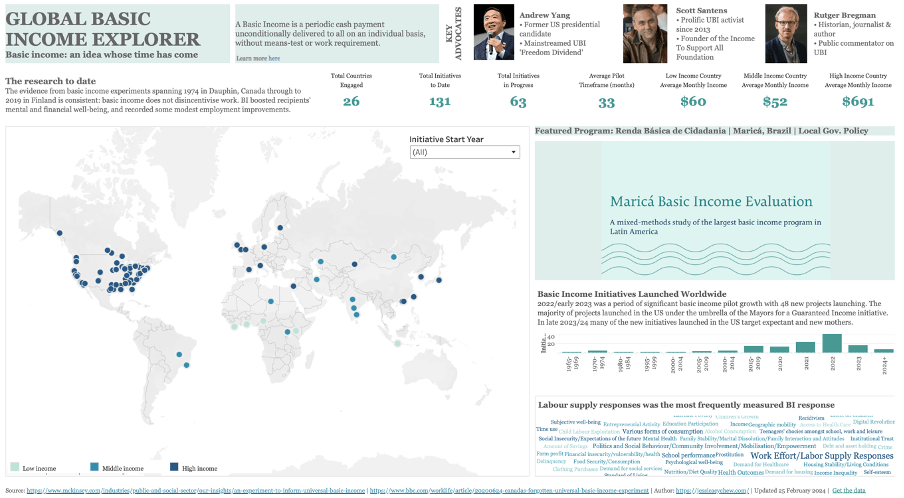
I am pleased to release the latest update of the Global Basic Income Explorer which aims to provide a broad update of basic income activities around the world. 

This update, covering May 2023 – February 2024, unearths three major themes.

  1. Slowdown in new basic income pilot launches
  2. Next wave of US basic income pilots targets expectant and new mothers
  3. Post-pilot thinking: Moving from successful trials to policy

1 | Slowdown in new basic income pilot launches

In 2023 and early 2024 approximately 30 basic income initiatives launched across the US, UK, India and Taiwan, which is down from a 66-initiative high between 2021-2022. 

Most basic income initiatives emerged in the US through small-scale city and county level trials that were partly funded by the US$350B American Rescue Plan Act (2021) COVID-19 stimulus package. State, local and tribal governments must ‘obligate’ the funds by 2024 and spend their allocations by 2026. The cluster of pilot launches around 2021 and 2022 demonstrate a period of rapid basic income program development to disseminate support to American communities in the wake of the pandemic. 

2 | Next wave of US basic income pilots targets expectant and new mothers

Baby’s First Years is a ground-breaking US study that assesses the impact of poverty reduction on family life and infant and toddlers’ cognitive, emotional, and brain development. In 2022 the interdisciplinary research team across neuroscience, economics, psychology, and social policy concluded:

“…an anti-poverty intervention had a direct impact on children’s brain development. After one year, infants of mothers in low-income households receiving $333 in monthly cash support were more likely to show faster brain activity, in a pattern associated with learning and development at later ages.”

In response, the 2023-2024 wave of US basic income pilots shifted focus from emergency income disbursement to proactive studies on the impact of cash transfers on expectant and new mothers in poverty and their babies. 

Key projects include:

  • RxKids basic income in Flint, Michigan USA disbursing US$1,500 during pregnancy and $500 each month throughout the baby’s first year to 1,200 expectant and new mothers per year;
  • The Humboldt Income Program in McKinleyville, California USA disbursing US$920 per month for 18 months to 150 pregnant people;
  • Mothers Rising for Guaranteed Basic Income in Los Angeles, California USA disbursing US$500 per month to 100 expectant and new mothers for two years.

These pilots operate against the broader backdrop of the US recognising the positive power of cash to improve children’s lives. In January 2024 with bipartisan support the House approved the expansion of the annual Child Tax Credit from $2,000 per child to $3,000 per child for children over the age of six and from $2,000 to $3,600 for children under the age of six, and raised the age limit from 16 to 17.

Despite the slower rate of basic income pilot growth, it is still great to see new initiatives being launched rapidly in response to the important Baby’s First Years research study. I recognise that these pilots are targeted to vulnerable populations that research suggests will experience outsized benefit from unconditional cash transfers. 

Ultimately, I am glad that the unconditionality agenda in welfare support is advancing through evidence-based and politically viable targeted initiatives such as basic income for new mothers. In time, I hope that these unconditional pilots graduate to permanent programs and pave the path to universality in basic income. 

3 | Post-pilot thinking: Moving from successful trials to policy

UBI academic and advocate Guy Standing’s recent essay title summarises this theme well – “Basic Income: Sufficient Evidence, Now Politics”. 

There are an estimated 130-200 basic income trials around the world that are either in progress or completed. UBI advocate Scott Santens drives home Guy Standing’s point succinctly: 

Some pro-UBI leaders such as Boston, Massachusetts USA Mayor Michelle Wu are taking heed and shifting the conversation from pilots to practical implementation. She states:

“What I have been struggling with when it comes to universal basic income is not the concept or the effectiveness of it, but how at the local level do we get to the scale where it can be sustainable and impact more than just a pilot program of say, 20 families or even 100 families.” – News From the States

In response, I would like to highlight two international policy initiatives that address Mayor Wu’s question. 

Apart from the oft-cited Alaska Permanent Fund as an example of a UBI-like program in practice, this update features Renda Básica de Cidadania, a local government basic income program in the Brazillian city of Maricá. It provides a US$39 per month basic income to approximately a 42,000 people, or a quarter of the city’s population. This basic income is paid in mumbuca, the city’s local digital currency. Similarly to the Alaska Permanent Fund, Maricá’s program is funded by a sovereign wealth fund that is capitalised by oil royalties and intends to guarantee basic income funding into perpetuity. 

Crossing over to South Korea, in July 2022 the Mayor of Seoul Oh Se-hoon launched the ‘Seoul Safety Income Project’ (SSIP), a pilot that provides financial assistance matching half of the difference between the median income and household income for low-income households in Seoul (median income: 85% or less; property: ₩326 million/US$255 million or less). The project’s aim is to address income inequality and precarity in the South Korean economy. 

South Korea is a basic income leader in the East Asia region. Support for UBI in the country is relatively high with 2022 Presidential candidate Lee Jae-myung only narrowly losing after campaigning on a UBI platform and having launched the 2019 Gyeonggi Youth Basic Income pilot in Seoul. Furthermore, details are currently emerging of a South Korean Basic Income for Farmers program. The SSIP pilot will run until June 2025 with impact analysis carried out through December 2026. 

This post will conclude on some technical updates on the Universal Basic Income Explorer. 

  1. The dataset behind the dashboard is now available on GitHub and can also be accessed through the dashboard (bottom right corner). 
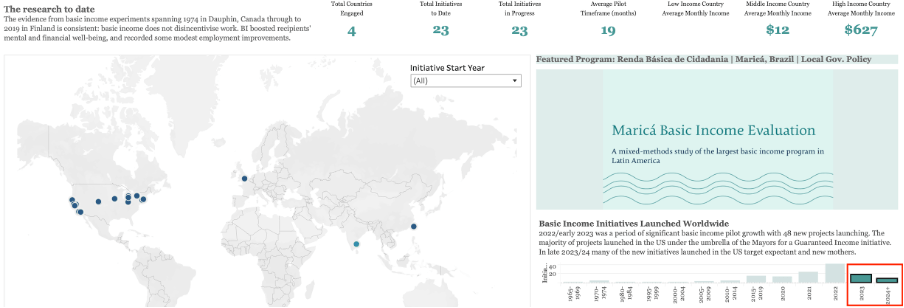
  2. Clicking on a time period in the ‘Basic Income Initiatives Launched Worldwide’ bar chart will dynamically filter the map by that same time period, including the summary statistics at the top of the page. Users can choose one or more time periods (by holding down the control button). This will aid users in understanding geographical clusters of projects over time. 

Before

After

Basic Income Australia UBI Calculator initial release

I have a longstanding interest in using my analytics background to build open-source data products to analyse Universal Basic Income (UBI). 

My goal is to build interactive web-tools that transparently, accurately and meaningfully model UBI proposals, focusing on their interactions with a given country’s existing social security arrangements. I would like my work to contribute to questions such as ‘How would we pay for a UBI?’, ‘Who would a UBI impact?’ and ‘What are the effective marginal tax rates across income deciles?’ as well as generally inform the public about UBI and other related social policies.

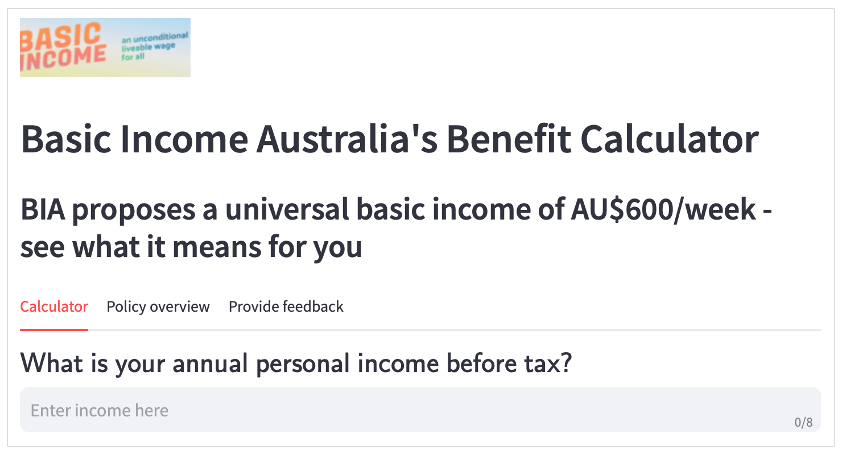
For my first interactive UBI project I have built a simple calculator that models Basic Income Australia’s (BIA) UBI proposal that is accessible here.

Users can enter their gross income and understand how they might benefit from the program and the mechanics of its design. The BIA proposal interacts with the Australian personal income tax scheme and the calculator user interface was partly based on the Australian Tax Office’s ‘Simple Tax Calculator’. The source code for the BIA calculator is fully available in a GitHub repo

This simple ‘version 0’ proof-of-concept UBI modelling tool does not take into account an individual’s HECS-HELP obligations, Medicare Levy Surcharge or Child Care Subsidies amongst other modelling considerations. It simply models the latest Australian personal income tax structure assuming you were a full-year resident for tax purposes.

My work is inspired by two international initiatives whose data products are much more advanced:

  1. The UBI Guy’s basic income calculator (US focus)
  2. UBI Center and their mission to make Universal Basic Income the world’s most thoroughly researched economic policy (US & UK focus)

I hope readers find this tool useful for understanding BIA’s basic income proposal for Australia. I welcome any feedback ranging from the source code, the UI/UX through to future UBI/social policy modelling suggestions.  

Circumnavigating politics with distributed technology approaches to Basic Income

The Australian Basic Income (ABI) Lab, a research collaboration between the University of Sydney, Macquarie University and the Australian National University, recently hosted an online workshop on social policy on 8th December 2023. As an ABI Lab fellow, I responded to the prompt below on ‘Security’ with a 12-minute presentation piece. 

ABI Lab workshop prompt:
We are now at the halfway mark of a new Federal Labor government. There have been some changes implemented in relation to social policy, but these reforms have fallen short of the expectations of many. What are we to make of the future possibilities for ensuring adequate, unconditional and regular incomes for all?

Basic Income can be used as a stimulus for asking particular questions and provoking debate about the status quo, rather than advocating for a Basic Income per se. 

In our Social Sciences Week seminar in September, Dr Joe Chrisp (University of Bath) argued Basic Income can be used as a mirror to highlight the most problematic and prominent features of a country’s social security system that shape the politics and policy landscape of social reform. Likewise, Kathi Weeks has long talked about Basic Income as a demand that does important political work.

We want to use this workshop to think with you about some of the key enduring questions that Basic Income raises, the kinds of important policy and political conversations underway, and the ones we still need to have.  

We have posed three questions centred on three themes that we think can help inform the Australian debate. We invite short papers or provocations that address one or more of these questions for the workshop. 

Security: How can we ensure economic security (income as a right) and reduce financial precarity?
Adequacy: How do we ensure everyone has ‘enough’ and address poverty?
Recognition: How can we value diverse contributions and recognise historical injustices beyond the rewards of the labour and capital markets?

I noticed an international trend of UBI actors electing not to wait for government action and instead trial digital solutions for distributing a basic income. The three applications I discuss are summarised below. 

My brief 11 slide presentation provides an overview and key details of the three technology initiatives above. You can access the slides here.

I wanted to focus on these organisations to highlight how external community/technology actors can implement UBI solutions that drive public interactions with UBI and hopefully subsequent political demand for scaled government programs. 

Ultimately, I think getting a UBI formally implemented in Australia and around the world will take a multi-pronged approach of government lobbying, activism as well civil society ‘just doing it’ like Comingle and GoodDollar. 

Global Basic Income Explorer Update – 2023

2022 and early 2023 continues the basic income momentum with 48 new projects launching, which is more than the projects launched between 2015-2021 combined! The majority of projects were launched in the US under the umbrella of the Mayors for a Guaranteed Income Initiative.

This update’s regional focus is the UK & Ireland with two unconditional pilot schemes underway in the Republic of Ireland and Wales, and a third slated for England.

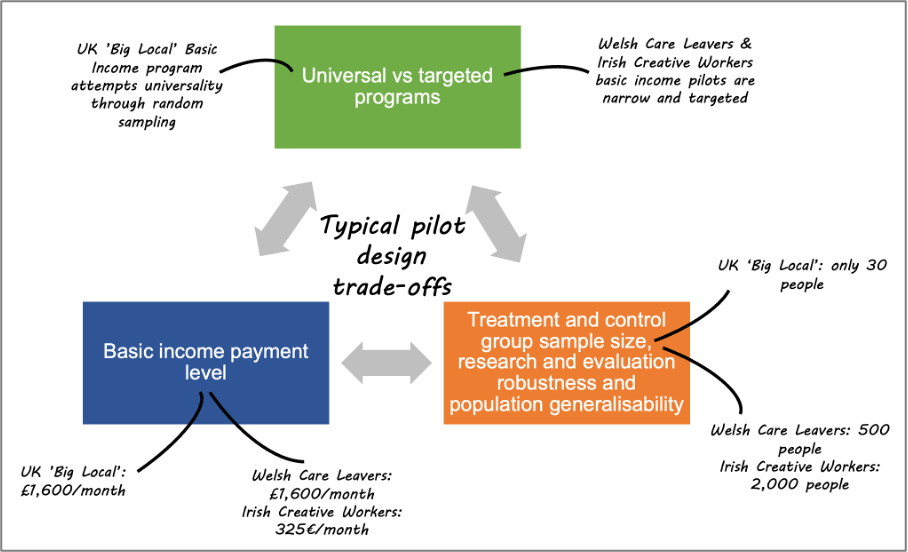
The government-sponsored Welsh basic income pilot is targeted towards care leavers who are turning 18 years of age between 1 July 2022 and 30 June 2023. It provides a monthly payment of £1,600 (£1,280 after tax) for two years to an expected 500+ recipients. Care leavers face significant and unique barriers to achieving a successful transition into adulthood, and this application of basic income seeks to ease their entry into adulthood.

Ireland also has a government-sponsored basic income program that is targeted towards creative workers which provides 325€ payment per week to 2,000 artists and creative workers for three years from 2022 to 2025. A control group of applicants who were not selected to take part in the trial will be established for evaluation purposes.

England is following suit with a UK ‘Big Local’ Basic Income two-year trial that is primed to launch once funding (likely from private philanthropic sources) has been secured. £1,600 per month is slated for 30 participants in Jarrow in North England and Grange, East Finchley. A control group of 30+ participants will also be established. To best emulate ‘universality’ given the micro-size of this pilot, the organisers will use a random sampling approach to recruit participants, with approximately 20% of places reserved for disabled people. 

The UK and Ireland basic income movement is active and exciting to watch. The three jurisdictions’ approach to basic income trials reflects in real time these following key design challenges and trade-offs:

The other key highlight from the latest Global Basic Income explorer is the UBI4ALL raffle. It is an initiative where anyone around the world can enter the monthly raffle to win an 800€ per month basic income for one year, totalling 9,600€. I think this is a nifty initiative that demonstrates how UBI momentum and action is not constrained to any one country or government. 

Conducting this latest dashboard update has been very encouraging, with society’s appetite for social welfare innovation driving an unprecedented number of basic income trials in the US, UK and Ireland. Although the majority of recent pilots are targeted in nature, I welcome these trials’ contributions to the basic income evidence base with the view and hope of moving towards a true unconditional and universal basic income. 

Universal Wellbeing Payment vs Basic Income Australia Comparison

On 26th – 28th September 2022, Australia hosted the 21st Basic Income Earth Network (BIEN) Congress in Brisbane. The aim of BIEN and its annual Congress is to offer education and a global platform for wide debate on basic income as an idea and policy option. 

This edition of Congress surfaced two substantial Australian universal basic income (UBI) proposals. The first is from Greens New South Wales MP Abigail Boyd titled the ‘Universal Wellbeing Payment’ and the second is by grassroots basic income advocacy group Basic Income Australia

Boyd’s contemporary platform on basic income is significant since the last major Australian political discourse on the topic occurred during the 1970s and 1980s and was driven by the Australian Labor Party (Arthur 2016). This level of interest mirrored the wave of North American basic income experiments featuring projects such as the Canadian ‘Mincome’ and a number of ‘income maintenance’ schemes across the several US states. 

Against the backdrop of a global COVID-19 pandemic, Basic Income is an idea that has regained traction in Australia in recent years with a 2021 Anglicare poll demonstrating that 77 percent of respondents (n=1000) support a basic income. Once again, BI momentum in Australia mirrors a resurgence in global interest as seen by the 100+ basic income pilot programs in the US as part of the Mayors for a Guaranteed Income initiative, GiveDirectly’s work in Kenya and Finland’s UBI trial amongst many others. 

Even more recently, the sharp global inflationary pressures in 2022 brought on by supply chain disruptions associated with Russia’s invasion of Ukraine have further compounded the wellbeing and financial stress for many. This in turn accelerates the need for transformative policies such as UBI to address today’s acute challenges.

With this economic and policy context in mind, this article prepares a high-level summary comparison on the key policy elements between the Universal Wellbeing Payment and the Basic Income Australia proposal that serves as a social policy conversation starter.

Section 1: Eligibility

AgeNSW resident 16+ years old18+
DisbursementIndividualIndividual
Citizenship statusResident or citizenCitizen, resident or refugee

For its first iteration the UWP intends to roll-out to New South Wales residents 16-years old and above with the intention for a future federal roll-out. The BIA policy targets nationwide 18-year olds and above and specifically includes refugees. 

Section 2: How much and how do we do it?

UBI weekly amountHenderson Poverty Line (~A$615)Henderson Poverty Line (~A$615)
Implemen-tation12-18 month rollout, replace benefits currently in CentrelinkStart at a low nominal amount, e.g., $10, phase up amounts per week up to the HPL over time (e.g., 5 years)
FundingFossil fuel levy, supplementary banking levy, overhaul of the stamp duty and land tax framework and borrowing
Central bank money creation

Both policies directly address poverty by setting their UBI amounts to the HPL, however the policies fundamentally differ in their funding approach; the UWP policy proposes new taxes whilst the BIA policy proposes money creation. The policies also differ drastically in terms of their roll-out periods with the UWP proposing a tighter one-year turnaround whilst the BIA policy proposes lengths of up to five years to start slow and gradually ramp up UBI payments to manage risk.

Section 3: How will certain groups be affected?

Both the UWP and the BIA proposals are largely comparable in how they intend to streamline and replace the current welfare support payments across various groups. The UWP proposal specifically outlines the provision of supplemental benefits for people with disability, whilst the BIA policy specifies a ‘no-worst-off’ approach to benefit replacement. 

People with disabilityUWP replaces the Disability Support Pension (DSP), but a supplement will provide for additional needs. National Disability Insurance Scheme (NDIS) payments persist.UBI replaces the DSP, except where the welfare benefit exceeds the UBI, the person receives the extra amount. Individual also receives any other ancillary benefits.
Age PensionUWP replaces the Age Pension.UBI replaces the Age Pension. Where the welfare benefit exceeds to the UBI, the individual also receives any other ancillary benefits.
ParentsThe UWP will replace the Carer Payment, the Farm Household Allowance, the Parenting Payment and ParentsNext.UBI replaces the relevant payments. Where the welfare benefit exceeds to the UBI, the individual also receives any other ancillary benefits. 
CarersUWP replaces the Carer Payment.UBI replaces the carer payment. Where the welfare benefit exceeds to the UBI, the individual also receives any other ancillary benefits. 
StudentsUWP replaces the Student Payment.UBI replaces the carer payment. Where the welfare benefit exceeds to the UBI, the individual also receives any other ancillary benefits. 

Section 4: Political viability discussion

Of the two proposals, the BIA policy is the incrementalist option compared to the UWP. As such, the Basic Income Australia proposal appears more politically feasible as it proposes how to implement a UBI without extra tax, debt or inflation, nor negatively impacting welfare recipients via a UBI authority and money creation. This is compared to the Universal Wellbeing Payment which proposes to fund the UBI through new taxes such as a fossil fuel and supplementary banking levy. 

Furthermore, the BIA policy proposes a very conservative phased-in UBI approach at $10/week that will gradually ramp up to the Henderson Poverty Line (HPL) over a five-year period. The intention of the BIA proposal is to allow supply chains to adjust to the slower increase in money in the economy and theoretically stave off demand side inflation. This approach is compared with UWP delivering the full UBI (approximately $615/week) from the outset. 

Section 5: Progressivity comparison

The two policies treat the UBI as part of an individual’s gross income which in turn determines their tax-free threshold. They both recapture the full UBI benefit after a certain point. UWP opts for the median salary (~$70K) as its threshold whilst the BIA policy opts for ~$81K (where 75% of the Australian population earns this amount or less). 

Both are progressive in that the more the individual earns, the less effective benefit they receive after paying taxes up until the point they become net contributors into the system. 

Threshold approach
(individual is a net beneficiary until earning this amount where they become a net contributor)
The Australian median wageApproximate salary for 75% of the Australian population
Threshold amount (individual benefits in decreasing amounts as their income increases up to this point)$1,344.70 p.w. or $69,924 p.a.
(Median wage source:
ABS May 2022, seasonally adjusted all employees average weekly total earnings)
$1,550 p.w. or $80,600 p.a.
(Source: ABS Characteristics of Employment, Australia, August 2017) 

Section 6: Poverty alleviation comparison

Both policies set the UBI at the Henderson Poverty Line however the implementation plans are starkly different. The UWP would address poverty immediately whereas the BIA proposal suggests a small nominal UBI, say at $10/week that ramps up to the HPL in a target period (e.g., five years). 

The BIA suggestion to start at, for example, $10/week may prove distasteful to, or be rejected outright by some poverty advocates who are demanding immediate increases to JobSeeker above the Henderson Poverty Line to address the acute needs of 3M Australians in poverty. 

The BIA policy’s five-year roll-out approach trades off meaningfully addressing poverty in the immediate term for political feasibility and inflation/economy shock risk management. The benefit of this approach, should the modest $10/week approach deem the BIA policy benign enough to pass into law, is that popular social welfare policies tend to have staying power once introduced. Examples include superannuation policy in Australia and social security in the US (NASI n.d.). In taking a long-term perspective, this five-year roll-out may not only have a higher chance of becoming a reality, but also give the whole country (as UBI is universal) a chance to enjoy the benefits. In turn the desired outcome is that UBI becomes an established and enshrined institution such as mandatory superannuation in Australia, social security in the US and the Alaska Permanent Fund.  

Despite the potential political viability of the ‘start small’ approach and long-term outlook, the BIA proposal does not compare in the short term to the UWP proposal in terms of providing rapid relief to acute poverty.

Section 7: Managing inflation

The two policies tend to treat the inflation question differently, with UWP largely omitting intervention options if inflation occurs after the introduction of UBI. Instead, the UWP policy suggests that potential inflation could be offset with entrepreneurship and cites that other basic income trials around the world have not reported inflation, which is corroborated by Santens’ research. The UWP policy however does acknowledge that luxury products are more likely to become expensive.

In contrast, BIA’s five-year phase-in approach allows the UBI authority to monitor the economic and behavioural impacts over time. If inflation occurs, the BIA policy suggests raising interest rates to dampen borrowing and if necessary implement a flat spending tax as a last resort. 

However, both the UWP and BIA proposals state that their respective basic income amounts will be tethered to CPI. 

Final thoughts: how do the two policies compare? 

Across the four key policy design elements of 1) current welfare benefit replacements, 2) UBI recovery approaches, 3) funding mechanisms and 4) policy roll-out approach, the UWP and BIA policies are aligned on half. 

Overall, they both seek to streamline the current welfare system and replace the various benefits at the same dollar rate or better, especially in the case for people with disability.

They both propose a UBI clawback design through the taxation system whereby individuals earning approximately the median wage (~$70-$80K per year) and above become net contributors into the system. 

The two policies diverge significantly regarding their funding mechanisms with the UWP proposing revenue raising through new taxes and the BIA policy proposing the creation of money via the Reserve Bank of Australia and a dedicated UBI Authority. 

The two policies also differ drastically regarding their roll-out periods where the UWP is proposed to roll-out over 12 to 18 months at the full HPL amount compared to the BIA’s proposal of incremental payment increases up to the HPL over a few years, say five.

These last two points of divergence will be the likely drivers of UBI policy debate, where trade-offs on political feasibility, economic sustainability and poverty alleviation effectiveness must be considered against the backdrop of a challenging global macroeconomic environment.

The instance of two substantial UBI proposals in Australia, one of which is authored by a representative of parliament, is a significant advancement for the UBI agenda. Opportunity exists to further engage the public through continued comparative policy debate and raise awareness and support in the community.

Author: Jessica Chew
This blog alongside others on basic income can also be found at
https://basicincomeaustralia.com/blogs/

BIEN Congress 2022 round up

I am posting a long overdue blog submission on the heels of the 21st BIEN Congress that was held in Brisbane, Australia between 26-28 September. I was fortunate to be invited onto the local organising committee (LOC) made up of mostly Australian academics and other grassroots volunteers. We had been planning this hybrid BIEN for so long (since February 2022) that it’s just such a relief, but also very rewarding to be on the other side of the event now!

The three days went by in a blur, especially since I was on the LOC helping to chair sessions, facilitate Q&A and be a general all-rounder. This blog will give me a chance to capture my overall thoughts on the sessions I was able to attend and note the sessions I’d like to go back and watch when the recordings are released (programme reference here).

Keynote address: Kathi Weeks in conversation and Q&A with Elise Klein
What a great, articulate speaker. I won’t do it justice here on my blog, but she spoke on feminism and basic income, and really deconstructed and analysed the different institutions we belong to. What will stick in my mind is her analysis of domestic chores and child-rearing as “privatised reproductive labour”. I’m putting her 2011 book The Problem with Work: Feminism, Marxism, Antiwork Politics and Postwork Imaginaries onto my reading list.

Jane Scott – Disability Activist & Blogger
‘How a Universal Basic Income could allow people with a disability to thrive’
Jane spoke of the frustrating and conditional bureaucracy of negotiating the National Disability Insurance Scheme. What particularly struck me was her assertion that disabilities are a normal part of being human, which is utterly true but I had just never heard it phrased that way.  The key takeaways are that a UBI could allow people with disabilities to further engage with society and thus be more visible, as well as spend the funds at their discretion. 

Dario Varcirca – Artist
‘Valuing creativity, criticality and care: the essential paradigm shift’
Dario’s provocation was that UBI would allow every person to become an artist. I think it’s an interesting frame that if we all had a UBI, we could all unleash our inner artist. 

Abigail Boyd – Greens MP
‘Building Power to Dissolve Power: Building Political Paths to UBI’ panel session
It was very encouraging to learn of an MP putting forward a complete and costed UBI proposal in Australia called the ‘Universal Wellbeing Payment’. Her policy is something I’ll need to look into. https://universalwellbeingpayment.com.au

Maiy Azize – Deputy director of Anglicare Australia
‘Building Power to Dissolve Power: Building Political Paths to UBI’ panel session
I’ve admired Maiy for a while now since I first heard her speak at the Australian Basic Income Lab inaugural workshop in December 2021. Her organisation has conducted a lot of research into the limitations, failures and cruelties of the Australian welfare state as well as Australian public attitudes towards UBI. However, Maiy states the work ahead is not technical but rather the need to tell better stories to change the hearts and minds of the public. As a technocratic data analyst, I especially take heed of her words ‘technical discussion erases the human experience’.

Te Rangikaheke Kiripatea – Projects Manager at Kai Rotorua Inc
Panel session: ‘Indigenous Perspectives on Basic Income’
Te Rangikaheke’s talk was perhaps the most striking. From the perspective of a Maori man, he bluntly advised that when communicating UBI to Maoris that the speaker should be young, Maori, have a good standing in the Maori community, understand UBI well and most of all; keep it simple. 

Janell Dymus – Māori Public Health Leadership COO
Panel session: ‘Indigenous Perspectives on Basic Income’
Janell shared a beautiful metaphor for describing the value of a UBI. She speaks of us all being on our personal mountaintops, each with differing heights that represent our varied and unique lived experiences and perspectives. A basic income allows every person to thrive no matter where they in life: on top of the mountain, in a valley or in the trenches. 

Alina Plitman – Philosophy doctoral student
‘Create vs. Toil: A New Concept of Work’
Alina’s presentation was about the different ways we think about work. She presented a few conceptualisations on ‘work’ as labour or hard ‘toil’ vs the creation of a body of work (such as an oeuvre). I mostly took from this the difficulty of labelling different kinds of ‘work’ (waged work vs unpaid care work vs hobbies). Perhaps I should more simply think of ‘work’ as an activity, and then I need to rest from that activity (even if it’s my hobby).

Jim Mulvale – Sociology professor
‘Is the Labour Movement Getting Onside with Basic Income? Views from Canada’
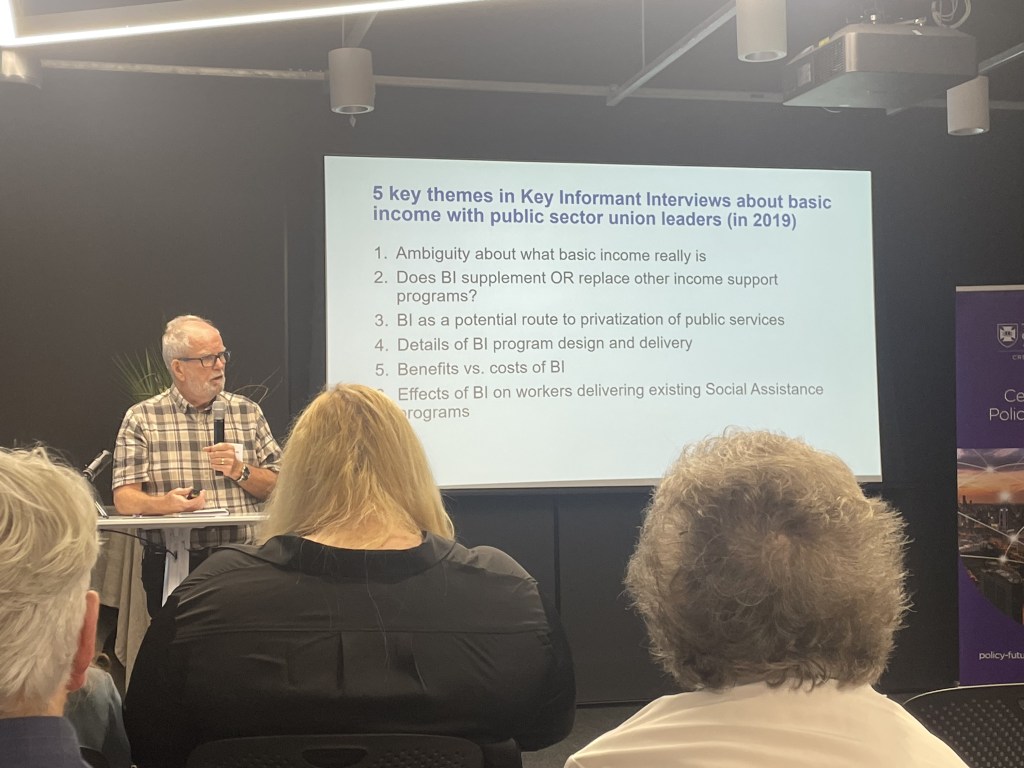
How the labour movement interacts/perceives UBI is a contentious space, with the labour union being primarily concerned with preserving the primacy of work and preferring job guarantee policy interventions. Jim provides a good summary of the research findings on Canadian unions’ views on UBI.

Jim Mulvale presenting the key questions the labour unions have on basic income

Considerations for UBI proponents when discussing with labour unions

Ibrahim Kuran and Sercan Pekel – Researchers
‘Public Opinion Towards Basic Income: Analysis of Twitter data (with the #BasicIncome Hashtag)’
Ibrahim and Sercan’s presentation concerning big data analytics was very close to my heart. Their research compliments existing survey data on attitudes towards basic income. I’ll have to check out their techniques when they share their code on git.

Michael Haines – Vanzi CEO Social and Economic Innovator
‘UBI: Without Extra Tax, Debt or Inflation, or Taking from Other Programs’
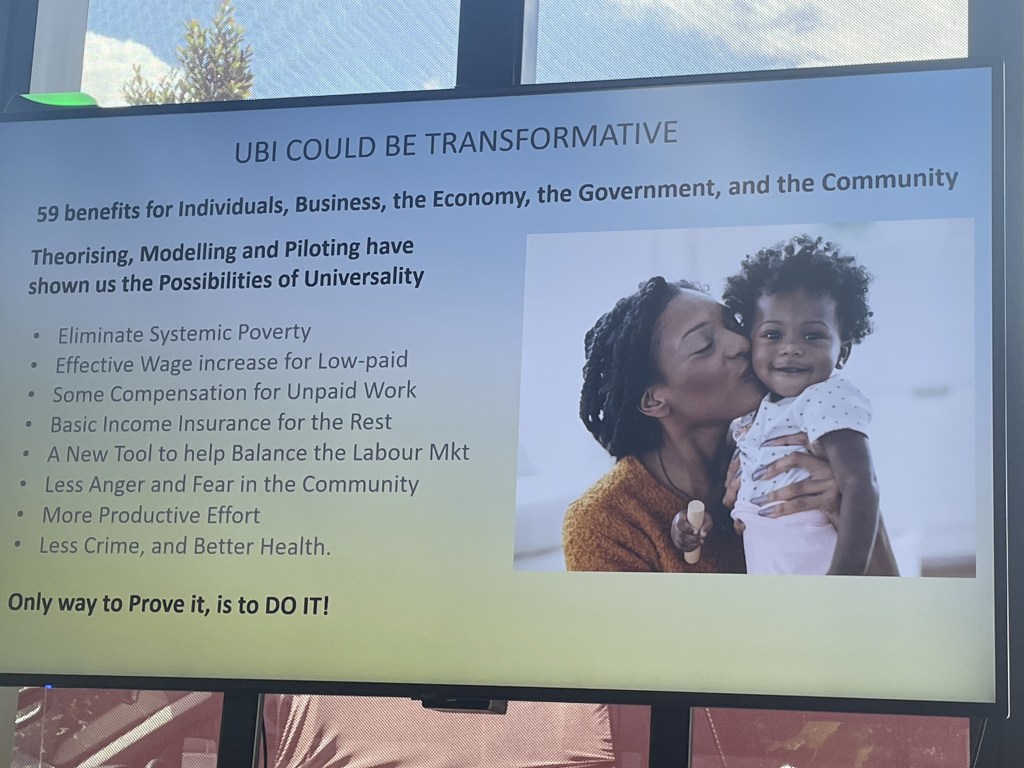
Through my volunteering with Basic Income Australia, I am familiar with Michael’s proposal to use sovereign money to fund a basic income. I look forward to following how this policy proposal progresses since its debut at this BIEN Congress. 

Michael Haines’ slide

Overall takeaways
BIEN 2022 was a huge leap forward for me in terms of my understanding of universal basic income and how I would like to contribute to its implementation in Australia. I walked away with two distinct impressions:

  • I still have much work to do to munge through and compare the various detailed UBI proposals out there.
  • There is a place for my interests in UBI modelling and microsimulation but from a political perspective, we need to focus on human narratives to drum up political support. (Harking back to Maiy’s warning that technical discussion erases the human experience.)

I still have some recordings to catch up on when they are released that mostly pertain to the various UBI modelling topics that I’m greatly looking forward to.

Now that Australia’s turn hosting the congress is complete, I look forward to hopefully making it to South Korea for BIEN 2023!

December 2021 Update: Basic Income Experiments around the World

I’m pleased to slip in an update to the worldwide Basic Income dashboard just before the ball drops (Australian eastern time) for 2021!

The 2020 – early 2022 period features an exciting groundswell of guaranteed income initiatives with 25 new projects launched, up 127% compared to the previous five year period (11 initiatives). That is an astounding appetite for basic income experimentation and research driven largely out of the US’ Mayors for a Guaranteed Income movement, with many more pilots to come.

Source: Global Basic Income Explorer

Huge acknowledgement must be given to Michael Tubbs, former Mayor of Stockton, California USA, who pioneered the first mayor-led guaranteed income project called the Stockton Economic Empowerment Demonstration (SEED) and sparked the movement we witness in the US today.

There are two other key callouts from this round of updates.

1) Four US cities: Gary – Indiana, Paterson – New Jersey, Seattle/Tacoma – Washington & Denver – Colorado carry on their bold legacy on basic income experimentation. These four cities conducted negative income tax experiments in the notable 1970s experimentation period and are stepping forward again in the 2020s as part of the Mayors for a Guaranteed Income movement.

The four major metropolitan areas with basic income experiments in both the 1970s and 2020s


2) A novel initiative arises from an Israeli cryptocurrency firm called Good Dollar in 2020. “The GoodDollar protocol is a community-driven, distributed framework designed to generate, fund, and distribute global basic income via the GoodDollar token (hereafter “G$”).” This is a fascinating basic income initiative to follow due to its (mostly) global and decentralised nature. Presently, any living person in Good Dollar’s included countries can sign up and claim a small amount of daily income in G$ coins.


Personally I view Good Dollar’s UBI initiative as a signal of basic income’s relevancy to the future of society and economies, much in the same way blockchain technologies are fast becoming mainstream in modern life.

Click here to view the updated basic income tracker.

2021 follows 2020 in being a difficult year. However, a glimmer of hope arises out of the COVID-19 crisis in the form of renewed hunger, advocacy and action in pursuit of basic income for a more just and secure world.

Happy new years and warm wishes for 2022!

Basic Income after COVID-19 – Social Security, Work & Wealth

On Friday 10th December 2021 I attended the Australian Basic Income (ABI) lab’s inaugural workshop. ABI is a research collaboration between the University of Sydney, Australian National University and Macquarie University. It’s an exciting group newly formed in 2021 which aims to be the preeminent hub for basic income research and outreach in the Asia-Pacific region.

Workshop introduction

Overall takeaways

First of all, what a great day! It was an all-day session filled with a diverse group of speakers ranging from social policy/economics academics, unions, nonprofit representatives and most importantly Aussies themselves who need and interact with Australia’s punitive welfare system.

One of the main thrusts of the discussion on Friday was how Australia implemented a sort of basic income ‘light’ during the height of the pandemic (a Jobkeeper supplement of $250 per fortnight with mutual obligation suspensions) which drastically improved the quality of life for those on Jobseeker – and then walked back the changes in a stroke of policy amnesia.

Nonprofits such as Good Shepherd surveyed Jobkeeper clients to learn more about their experiences. Below is a very brief snapshot of some of the positive impacts on recipients:

  • Feeling less alone
  • Feeling themselves for the first time in years
  • Able to buy good food, exercise

I’ll use this blog post to as a quick round-up of the key notes and takeaways I drew from the three sessions.

Session 1Organiser overview

Session 1 notes

Maiy Azize – Deputy Director, Anglicare Australia

  • Anglicare divested from employment services about a decade ago because of the exploitative nature of being a contracted Australian job service provider
  • Australia’s welfare system is amongst the most compliance-heavy regimes in the world
  • Welfare states feature a care vs control duality – with Australia leaning further into the latter

Kristin O’Connell, Anti-Poverty Centre & Australian Unemployed Workers Union

  • Focusing on the question ‘how to live lives with purpose?’
  • People are not just mechanised parts of an economy
  • Key concept: “Conditionality is the engine of the party machine”

Session 1 summary thoughts

This session was the most raw in terms of discussing the positive impacts of improving Jobseeker payments and suspending mutual obligations. These temporary policy amendments drastically improved people’s lives – only for the status quo to be reinstated.

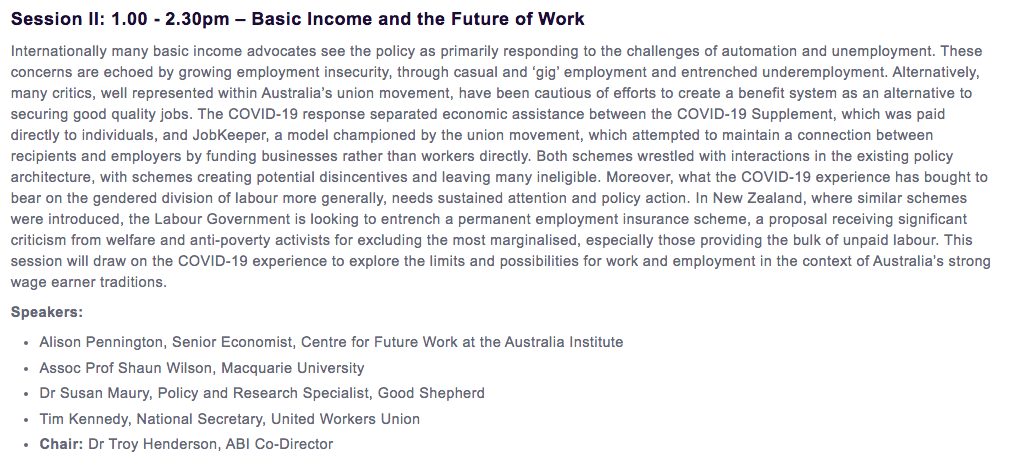
Session 2 – Organiser overview

Session 2 notes

Alison Pennington, Senior Economist, Centre for Future Work at the Australia Institute

  • A distance has grown between work and income
  • Unemployment is planned, not structural – women are priced out of being wage labourers, with the high cost of childcare
  • There is a high level of underutilisation in Australia
  • The Australian nurses’ union is a good example of an industry that was mostly dominated by women which organised to become one of the most powerful unions in Australia

Assoc Prof Shaun Wilson, Macquarie University

  • Author of new book Living Wages and the Welfare State: The Anglo-American Social Model in Transition
  • Proponent of the broad progressive potential of a living wage
  • Challenges for UBI
    • Not winning support from Piketty & Krugman
    • How to put an electoral coalition together

Tim Kennedy, National Secretary, United Workers Union

  • The UWU advocated for keeping a high jobkeeper
  • Notes worker fragmentation and loss of solidarity
  • Current organising campaign is “jobs you can count on”
  • UWU’s position on UBI ranges from ambivalent to contested
  • The union focuses on worker power rather than waiting for governments
  • UWU meets their members where they’re at – 1st order of business is addressing wage suppression
  • BI doesn’t address asset inequality
  • BI is on the horizon for unions, has potential to inform UWU’s ‘theory of winning’

Session 2 summary thoughts

A fascinating session that helped me to better understand the role and enduring relevance of unions in the context of a potential UBI. Income security is an outcome for both the union and UBI movements. However, this session reinforced awareness in me that workers have powers to seize the means of production and improve their bargaining position – whilst the basic income movement is dependent on putting together an electoral coalition. The key takeaway here is understanding how union actors may view UBI as an inferior tool compared to industrial action when considering their theory of winning for workers.

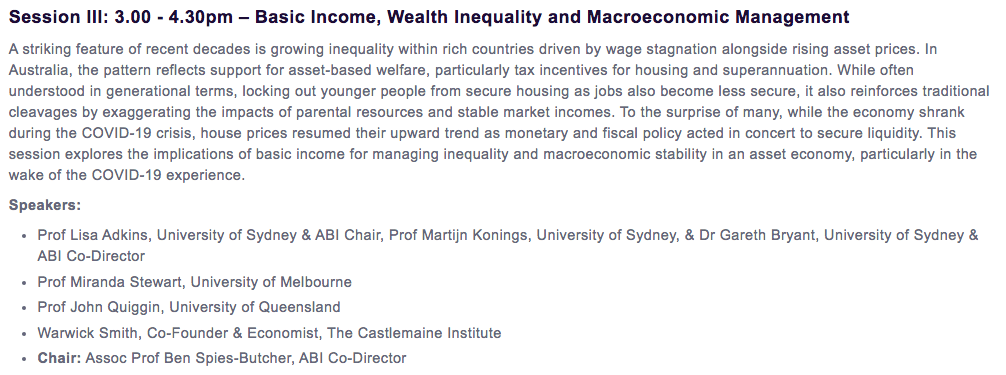
Session 3 – organiser overview

Session 3 notes

Martijn Konings, University of Sydney

  • The economy is characterised as an asset economy featuring asset inflation
  • The economy can be described as a post-Keynesian political economy

Professor Miranda Stewart, University of Melbourne

  • An asset like home ownership is not taxed apart from stamp duty

Session 3 final thoughts

The key takeaway I got from this session was that labour has been divorced generating wealth, and that the key driver of wealth nowadays is in holding assets. I feel particularly grim about the outlook of people (young people especially) who can’t get a foothold into the asset economy and hope to learn more about how basic income may contribute to the solution.

Concluding thoughts

A big thanks to Dr Troy Henderson, Dr Elise Klein & Dr Ben Spies-Butcher for organising the workshop! Overall, it was a thought-provoking day with lots of two-way interaction between the panelists and attendees in each of the three sessions. My main question is how resonant within the Australian consciousness are the stories of those who benefitted from the basic income-esque natural experiment? How do we as basic income advocates leverage the momentum out of the last two years of crisis to evolve Australia’s punitive and inefficient social policy and make the good changes stick?

I recently got invited to join the local organising committee for the 2022 Basic Income Earth Network’s congress which is going to be held in Brisbane next year (hybrid online & in-person). I look forward to exploring my above questions further there.

Universal Basic Income: More affordable than at first glance

Pragmatic questions

As much focus as there is on the why of a basic income model such as Universal Basic Income (UBI) (examples here, and further reading here), advocacy efforts also need to address the how of implementing the program. Four critical ‘how’ questions are:

  1. How much does it cost?
  2. How are we going to pay for it?
  3. How do we institute a no harm UBI so that beneficiaries currently relying on social safety net programs are not net worse off?
  4. How do we structure a UBI program where we meet everyone’s basic needs, but it still pays to work?

This post is mainly going to address the accounting methodology of question 1 and will lean heavily on the US context for its examples – but the cost estimation methodology will apply in most country contexts.

Some of the defining critiques of the UBI model involve its cost, with figures quoted at US$3 trillion per year, and at a cost of 20-35% of GDP. However, these critiques use a faulty cost calculation whereby the cost is the UBI amount given to each individual multiplied by the size of the population. In the $3 trillion/year example, this would equate to a $10,000 UBI multiplied by the US population (300 million).

However, UBI as a redistributive program is quite unique to other entitlement programs in that some recipients of UBI are simultaneously contributors to the UBI funding pool via their taxes. In order to meaningfully arrive at a cost estimate for UBI, the methodology must consider the positive tax contributions of those recipients in order to arrive at the net cost.

This methodology is based on the works of Karl Widerquist, prominent thinker and writer on basic income. It is also well summarized by Elizaveta Fouksman.

“Here’s a simple example: imagine a room with 15 people who want to set up a UBI for the room of $2 per person. The upfront cost of the policy would be $30. The ten richest people in the room are asked to contribute $3 each towards funding it. After they each put in $3, raising the total $30 needed, every person in the room gets their $2 universal basic income. But because the ten richest people in the room contributed $3, and then got $2 back as the UBI, their real, net contribution is in fact $1 each. So the real cost of the UBI is $10.”

The upfront or gross cost in Fouksman’s example is reduced by a third.

Widerquist models a ‘back-of-the-envelope’ estimate of a UBI program set at the official US poverty line of $12,000 per adult and $6,000 per child with a 50% marginal tax rate (page 6). His estimate, after netting out the contributions of richer UBI recipients, lands at $539 billion per year, which is about 1/6th of the gross cost of $3T, and constitutes about 2.95% of GDP.

Methodology discussion – the salient points

The key to gaining true insight into the cost of UBI is to distinguish between gross upfront cost and the real net cost. Again, Fouksman outlines it best. This net-cost concept is fundamentally important to understand, because most other transfer payments are designed to flow to those who do not contribute into it. Fouksman highlights a fundamental blind spot with most gross UBI calculations – those who pay for UBI through their taxes, will also receive a UBI – negating some of the cost of contributing to UBI in the first place.

Another angle with which to examine the true cost of UBI: although a UBI will be paid out to all members in society – because the rich have already paid for their share of UBI via their taxes, their payouts need not be included in the UBI cost estimate.

Widerquist presents yet another way to understand the accounting: “UBI involves a very large amount of taking money from and giving back to the same people at the same time in the same form. If you don’t account for all this taking-and-giving-back, you can’t get a realistic assessment of how much UBI costs or of the distributive benefits and burdens it involves.”

From this we can begin to understand when one is a net beneficiary, when one is a net contributor, and the rate at which people gradually switch over from beneficiary status to contributor status as their incomes improve.

Outcomes of understanding the UBI net-cost estimation methodology

Current UBI cost estimations are grossly overstated and misleading, and do not contribute meaningfully to the debate on why and how UBI could be implemented. In Widerquist’s poverty-level UBI example, such a program in the US would cost $539 billion per year, which is just 25% of current US entitlement spending and approximately of 2.95% of GDP.

Understanding the net cost of a UBI is very significant in advancing the policy discussion around whether or not basic income schemes should be universal.

Under a UBI scheme, every member of society should expect a regular income, irrespective of their existing wealth or work status. This would mean billionaires such as Jeff Bezos and Bill Gates would receive a basic income – a concept that at first glance seems obscene.

Since learning more about this topic four years ago, I knew that I broadly supported a UBI due to its inclusiveness, and the reduction in stigma of receiving government support (due to the universal nature of the payment). What I didn’t know was how I felt about the wealthy also receiving the guaranteed income. What I personally hadn’t considered was the differentiation between a net beneficiary of UBI and a net contributor. I hope that knowledge of the net cost of UBI better circulates in public debate, as well as the knowledge that we can afford it, should we choose to.


Universal Basic Income Experiments around the World

The concept of Universal Basic Income as an economic and social vehicle to recommit to the social contract has been experiencing a renaissance over the last few years – increasing in public consciousness and political discourse.

I’m happy to share my latest project – a Tableau data visualisation showcasing past and present Universal Basic Income projects around the world. This project was completed piece by piece over many weekends – combining my love for data visualisation and social welfare innovation.

Click on the viz preview below to visit Tableau Public and interact with the visualisation!
Basic income explorer preview

I hope this visualisation serves as an effective starting point for your exploration of UBI initiatives around the world.